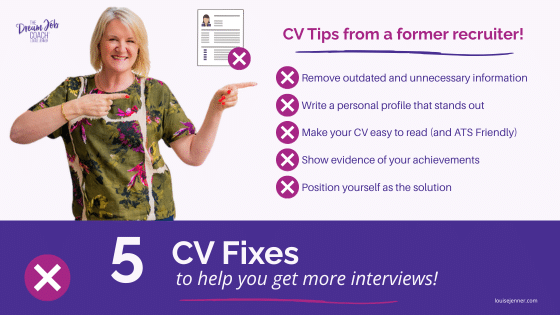
5 CV Mistakes That Stop You Getting Interviews
(And How to Fix Them)
Can we be frank with one another?
If you’d prefer me to beat about the bush, this might not be the article for you. I’m in a straight-talking mood today.
Over the years, I’ve reviewed hundreds of CVs both as a recruiter and as a career coach.
And do you know what?
The same issues come up again and again.
The very things that used to make me quietly scream when I was screening CVs as a recruiter are still showing up now that I’m The Dream Job Coach. So today I’m on a mission to get rid of them once and for all.
Quick question before we dive in…
If you’re currently job hunting and wondering why your CV isn’t getting the response you hoped for, you’re very welcome to book a free Career Clarity Session with me.
We’ll look at where you are now, where you want to go next, and what might need tweaking to help you get there.
Now, let’s look at my top five CV offenders, in no particular order, followed by the big one.
All viewed through what I call the employer mindset.
1. “I work well on my own or as part of a team.”
Yes. You and everybody else.
This sentence appears on thousands of CVs and tells an employer absolutely nothing about you.
Instead, show evidence.
Give a short example of when you collaborated with others or delivered something independently. Employers believe examples and results, not vague statements.
For example:
• Did you lead a project?
• Improve a process?
• Help your team achieve a target?
Those are the things employers care about.
2. “References available on request”
Employers already know this. Hopefully, they’ve already checked out your recommendations on LinkedIn!
If they want references, they will ask for them later in the process. You don’t need to use valuable CV space telling them something they already expect.
3. Your date of birth
You don’t need to include it.
Age discrimination laws mean employers should not be using age as a factor when making hiring decisions anyway. And realistically, people can often estimate your career stage from your qualifications and employment history.
So save the space.
4. Your full postal address at the top
Traditional CV templates used to include a full postal address right at the top of the page.
But ask yourself this question: Is where you live really the most important thing you want to tell an employer first?
Today, a town or region is usually enough, alongside your phone number, email address and LinkedIn profile.
That space can be used far more effectively to showcase your value.
5. Irrelevant jobs and qualifications from decades ago
Your CV should focus on the experience that matters now.
Listing every job you’ve ever had since school can dilute your message and distract from the skills that are most relevant to the role you’re applying for.
Employers want to see the best and most relevant version of you today, not a history lesson.
And now the big one…
Your personal profile
Or, as I sometimes call it, the most wasted space on many CVs.
When you read your profile back, ask yourself two questions:
Could this paragraph only be about me? Or… Could this be about almost anyone?
If your answer is yes to the first one, brilliant. If it sounds upbeat, specific and compelling, I’ll happily shake your hand and say: “Good luck in your new job.”
But if you find yourself thinking, well… that could apply to almost anyone, then it’s time for a rewrite.
Employers don’t want to hire anyone.
They want to hire someone: A real person who can solve their problems, help their team and deliver results.
Not sure if your CV is helping or hurting your job search?
I review CVs every week and I still see talented professionals unknowingly making simple mistakes that cost them interviews.
If you’d like expert feedback on yours, you can book a free 90-minute Career Clarity Session and we’ll look at:
• where your CV may be holding you back
• how to position your strengths more clearly
• the best strategy for finding your dream job
A quick word about LinkedIn
Your CV is no longer the only place employers will look.
Many recruiters will search for your LinkedIn profile before they even read your CV, and sometimes instead of it.
So make sure your LinkedIn profile:
• reflects your current career goals
• shows evidence of your achievements
• includes recommendations from colleagues or clients
Think of LinkedIn as your professional showcase, and your CV as an advert.
And what about ATS?
Many organisations now use Applicant Tracking Systems (ATS) to screen applications before a human even sees them.
That means your CV needs to be:
• clear
• well structured
• easy to scan
• focused on relevant keywords from the job description
Overly complicated designs, graphics and unnecessary information can sometimes make it harder for these systems to read your CV properly.
Another good reason to keep things simple and focused.
So what should you do instead?
Be human.
Tell them about you, and more importantly, what you can do for them.
Join the dots.
Explain how the work you’ve done, whether that’s in a job, at university, volunteering, freelancing, travelling or during a career break, relates to the role you’re applying for now.
Show them:
• what you’re proud of
• what you’ve achieved
• what you enjoy doing
• where you want to go next
Give examples. Mention results. Share links to your LinkedIn profile or portfolio if relevant.
Help them see the value you could bring.
Your dream job is worth the effort
A strong CV doesn’t just list your past.
It tells the story of the contribution you’re ready to make next.
And when you get that right, everything else in the job search becomes easier.
Would you like some help with your CV?
If you’d like expert support reviewing or rewriting your CV, I’d love to help.
You can book a free Career Clarity Session where we’ll look at where you are now, where you want to go next, and what needs to change to help you get there.
Because your dream job is absolutely worth it. 🤩